
Welcome to Firefly City!
Which story would you like to visit?
Bluefire Books
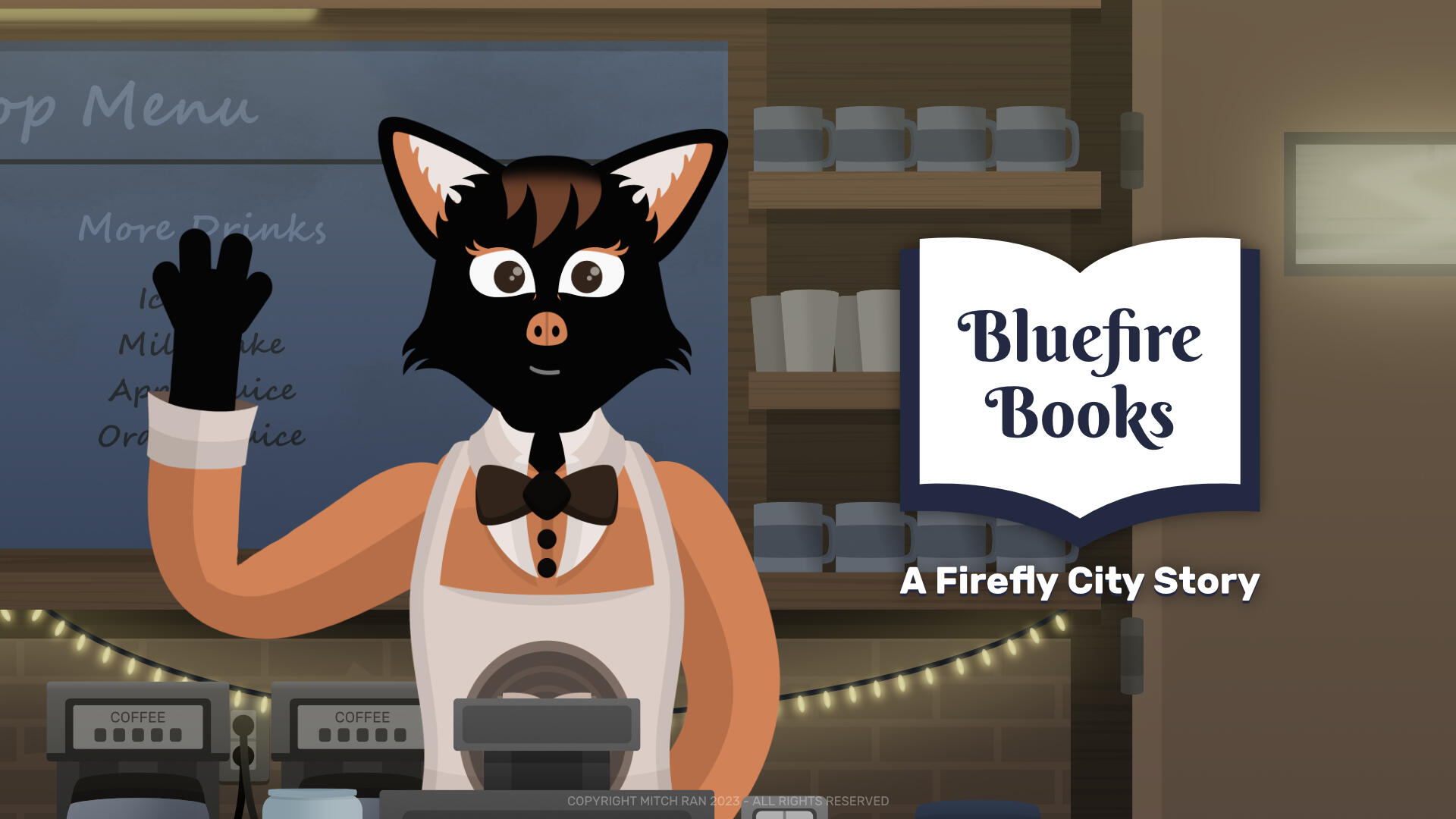
A slice-of-life webcomic featuring Samantha and her new book café in Firefly City. As she struggles to keep her shop afloat, Sam runs into all kinds of unusual conundrums.
Where's Willow?
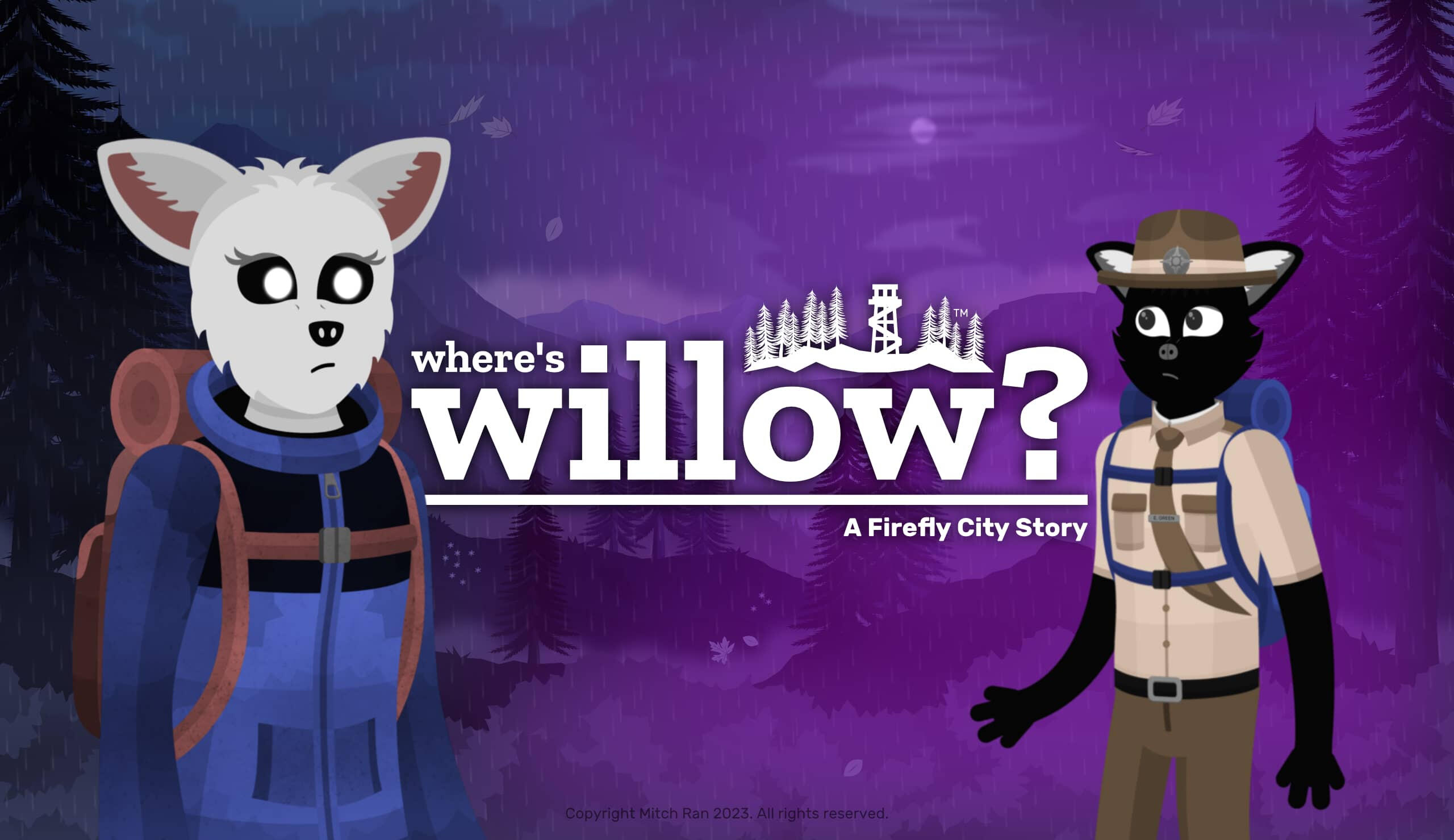
A complete 10-episode indie animated series featuring the story of a missing hiker, an isolated park ranger, unforgettable memories, and some ghostly mountain mischief.
Pilot Light
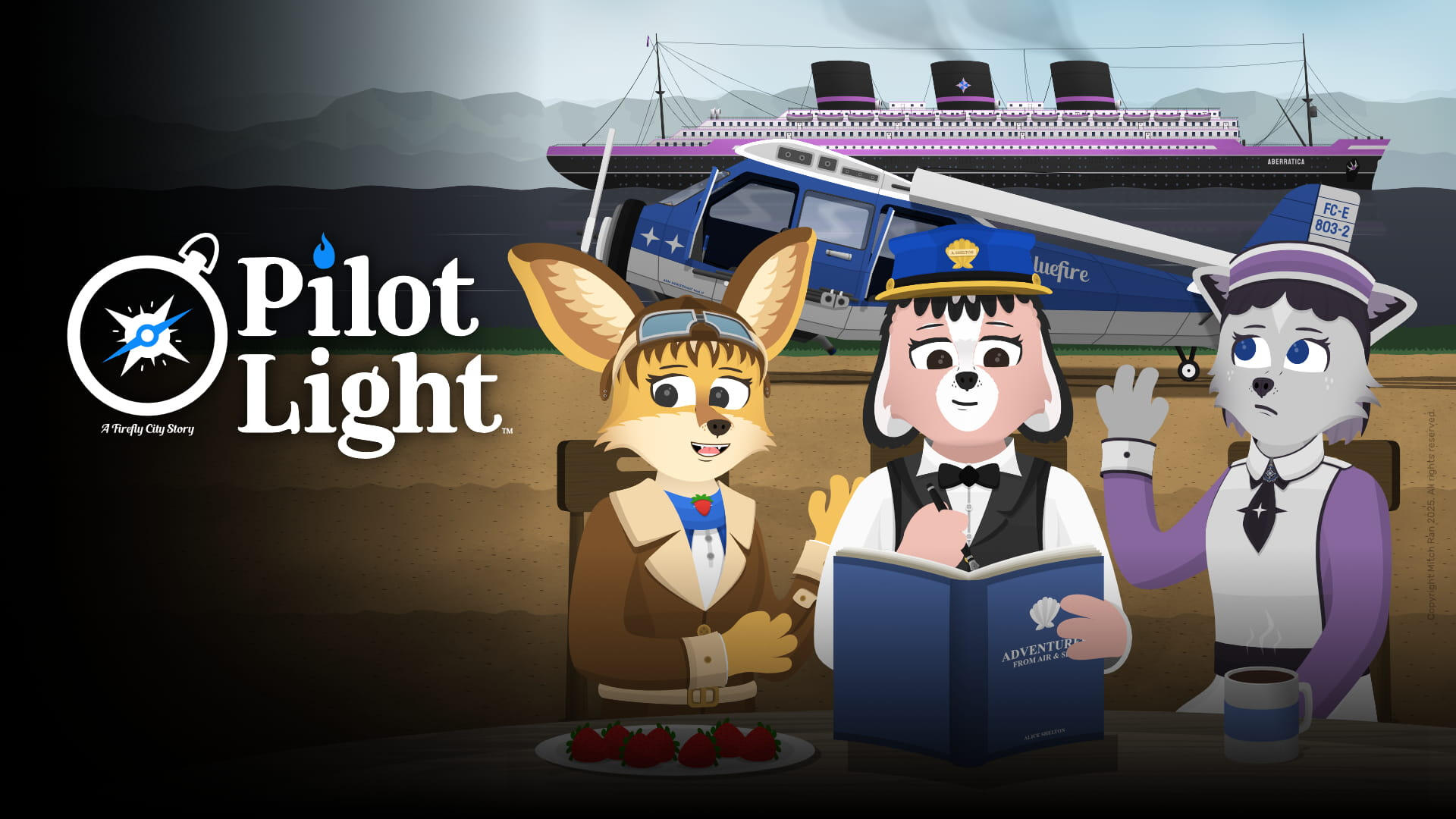
An indie animated series about a daredevil pilot, a cautious lighthouse keeper, and a jaded ocean liner stewardess as they face a world of unknown futures and haunting pasts.
More Coming Soon!
Want some small hints about some of the new stories that might join the Firefly City Stories universe in the future? Check out this list of cryptic clues and give it your best guess!
More FCS
Extra Firefly City Stories info and content!
Support FCS!
Subscribe for early access and backstage content on Patreon, make a single donation on Ko-Fi, or grab something from the shop! Support is very much appreciated!
FCS Shop
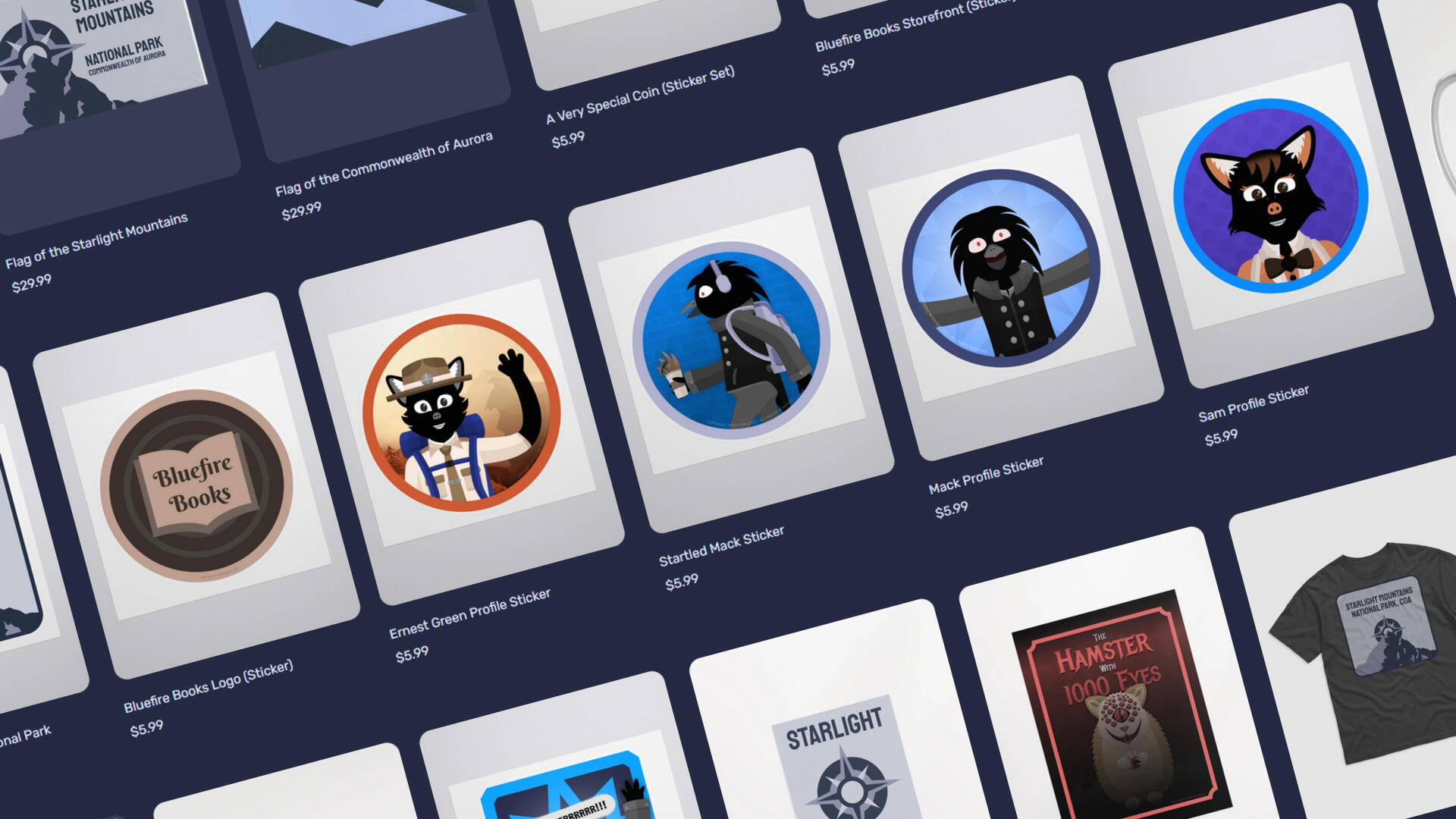
Grab yourself some cool merch from Where's Willow?, Bluefire Books, and other Firefly City Stories projects! Proceeds help support the creation of more shows, comics, and stories!
FCS Music
Listen to the official music soundtracks of various Firefly City Stories, as well as other tracks by creator Mitch Ran. Soundtracks can be streamed or purchased for download!
About FCS
Discover more about the universe of Firefly City Stories along with background details about production and inspiration. Check out maps, deeper lore, timelines, and more!
About Firefly City Stories
Hi! I'm Mitch Ran, the creator of Firefly City Stories. I'd like to share the background on FCS and its production with you!Throughout this page I've tried to describe everything in detail while keeping it organized and readable in chunks. I have links to things that might be of interest, but none of them are sponsored or anything. They're just there for if you're curious. I hope it's interesting or even helpful to you!
What is Firefly City Stories?
Firefly City Stories (I often abbreviate this as “FCS”) is a collection (or anthology) of comics, animations, and other media set in the fictional location of Firefly City and its surroundings. Each subproject explores aspects of young adult (and later) life, and focuses on how the different mindsets, experiences, and stories of characters can intertwine, mix, and affect each other.These stories primarily come from abstractions of personal experiences of both myself and those close to me. When I say “abstractions,” I mean that the stories aren’t literal retellings of things that have happened, but instead are mixed up, simplified, and distilled versions that are designed to be more universal while retaining their meaning.
How are FCS projects made?
Depending on the type of project (comics, animations, or something else), there can be several different pieces of the FCS project workflow. Below they are listed in the general order that I usually follow them in.
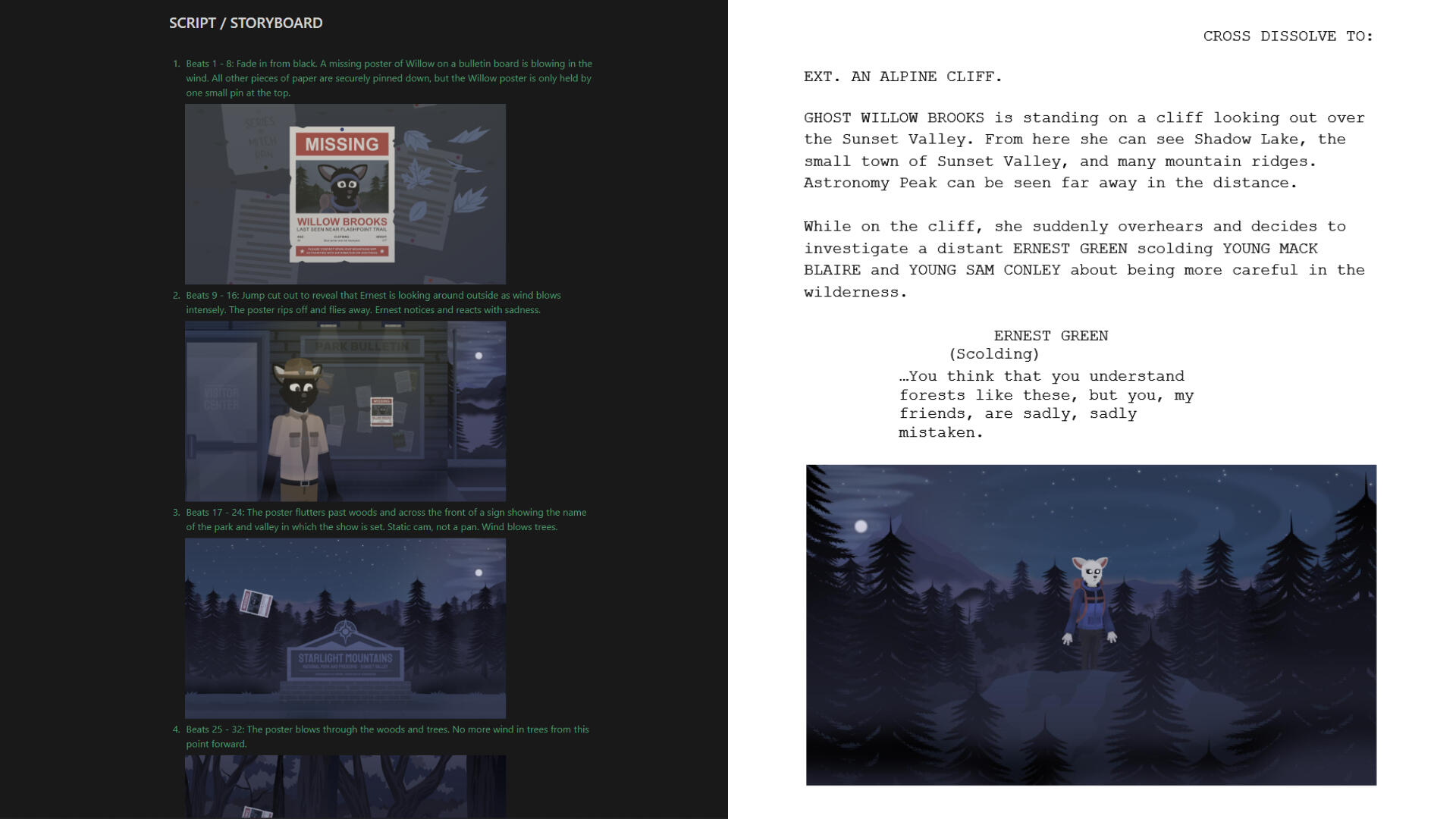
An example of the script/storyboard creation from Where's Willow?
Writing:
• Writing for Firefly City Stories starts with a look at the worldbuilding, maps, and other prior stories in the FCS collection so far (see the lore page). I want to make sure that each story can cleanly exist in the same universe as the others without breaking continuity or introducing any unintentional paradoxes or plot/lore holes.
• Alongside the existing world lore, I also look for (or sometimes already have) a few key pieces of inspiration that made me want to write a particular story in the first place. These are usually first and foremost personal experiences in my own life, but can also include video games, books, and real-world events that have a particular impact on me.
• I usually start writing in a notes app before eventually moving things to a more standard document where I can organize them.
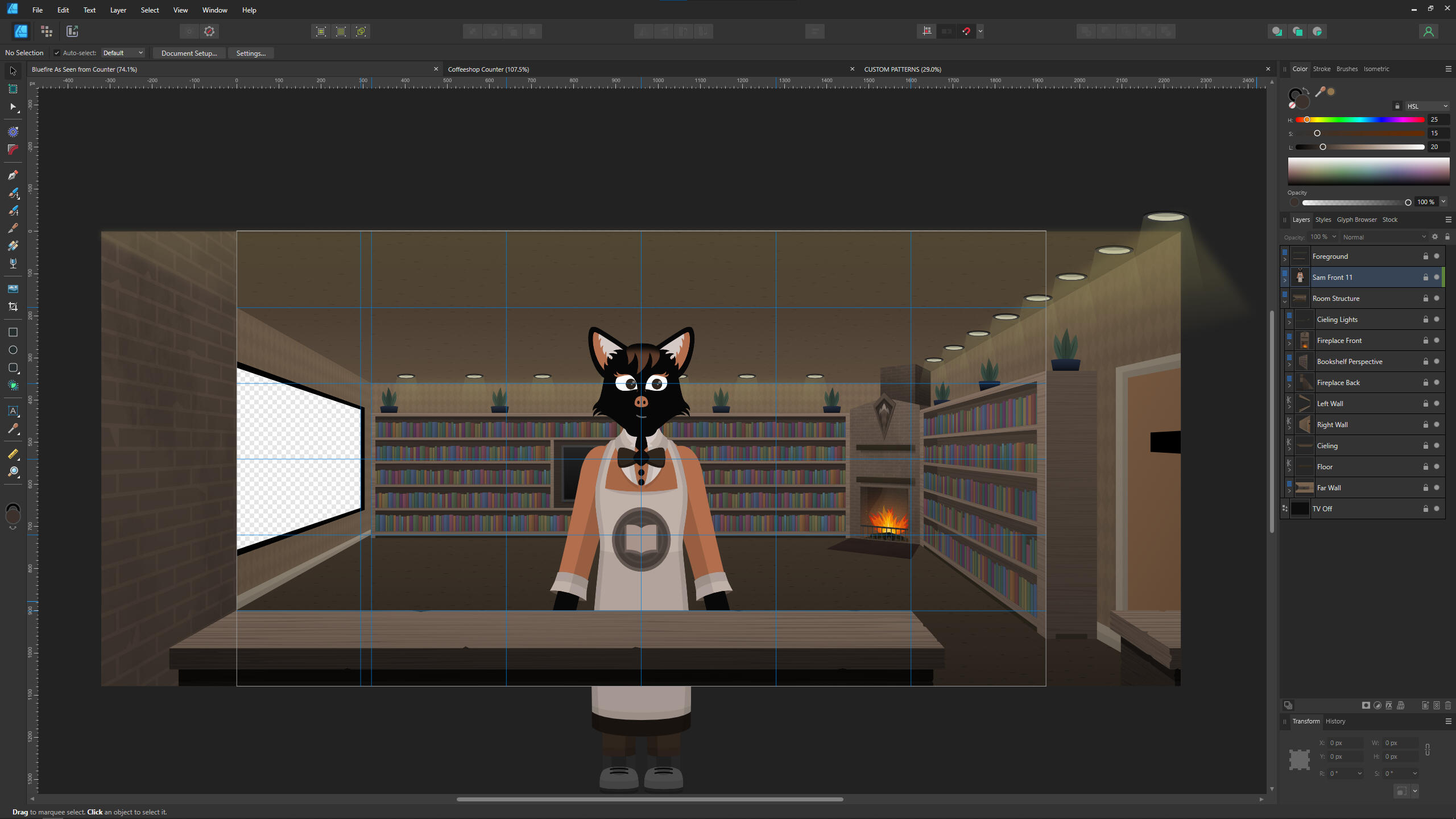
A screenshot from the making of the counter POV in Bluefire Books.
Artwork:
• Artwork is made in 2D vector format (never raster) using Affinity Designer and occasionally Krita. I use vector instead of raster because it allows me to adjust and reuse work where possible, saving time as a single-artist operation. This is essentially the same way that many video games are made, and a video game idea (ironically, still unfinished lol) was what led to me creating Firefly City in the first place.
• Occasionally, I will do pieces of artwork in real life with physical media as well and incorporate it into projects. The types of physical media I use can range from simple colored pencils and printer paper, to index cards, to oil pastels and charcoal on vellum. An example of this can be seen in Where's Willow? in that Willow's sketchbook actually exists in real life except the cover is yellow and branded with a real company (lol). I also make physical printouts and mockups to test the believability of several of my in-world posters, maps, documents, and even character outfits (I have real world versions of Ernest's uniform, Willow's jacket, and Sam's coffeeshop apron, for example).
• I also often include photographs that I take in real life. My camera is a bit old at this point (A Nikon D5200), but it still gets the job done, at least for FCS. Some other pictures I just take using my cellphone. Sometimes I also find a use for older pictures I've taken on various vacations and trips.
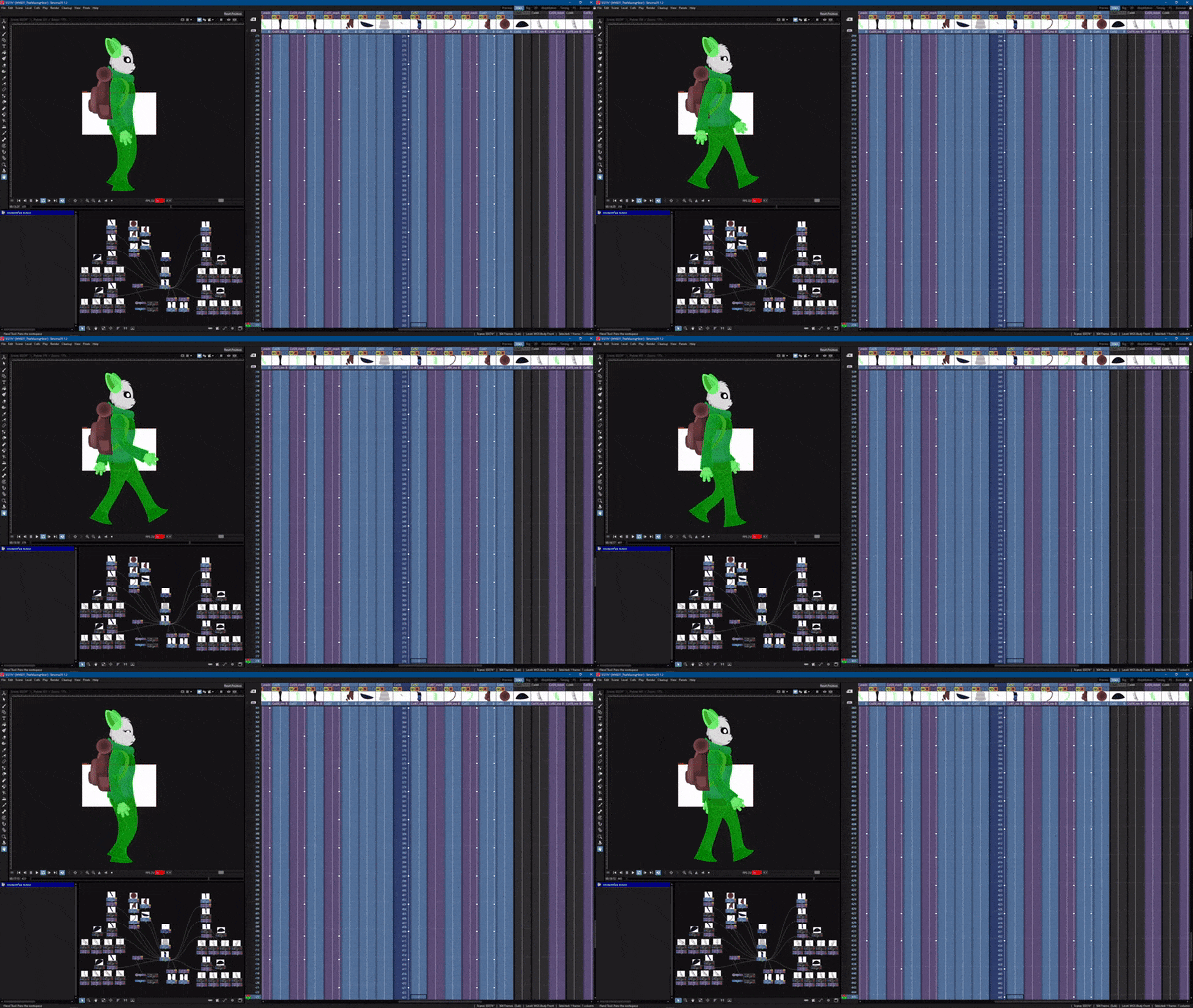
A screen recording of the animation for a Willow walk cycle. (I had to heavily compress this gif to make it load, sorry lol).
Animation:
• When planning out animations that I have already written a synopsis for, I usually combine the full scriptwriting, artwork, and storyboarding process to save time. I can make the artwork of a setting, pose the vector rigs of the characters within them, and use that to block out how each clip will go and the dialogue and action that needs to happen in each. This takes place using a combination of Affinity Designer and the documents I make during the writing stage. This is only possible because I work on these projects solo, and it lets me anticipate animation challenges and fix them in advance within the script and artwork layers.
• Animation for Firefly City Stories projects is done using Tahoma2D, which is an open-source fork of Opentoonz. (I've also used Moho Pro before but it was never critical to the project). In order to make animation manageable as a one-person operation, I use character rigs (which is also another reason why all digital art in FCS is vector). While it may not be as dynamic as frame-by-frame, it still allows me enough expressiveness to get my points across (especially after working this way for several years), and pays huge dividends as far as saving time. It also lets me animate at 24 on one and high definition.
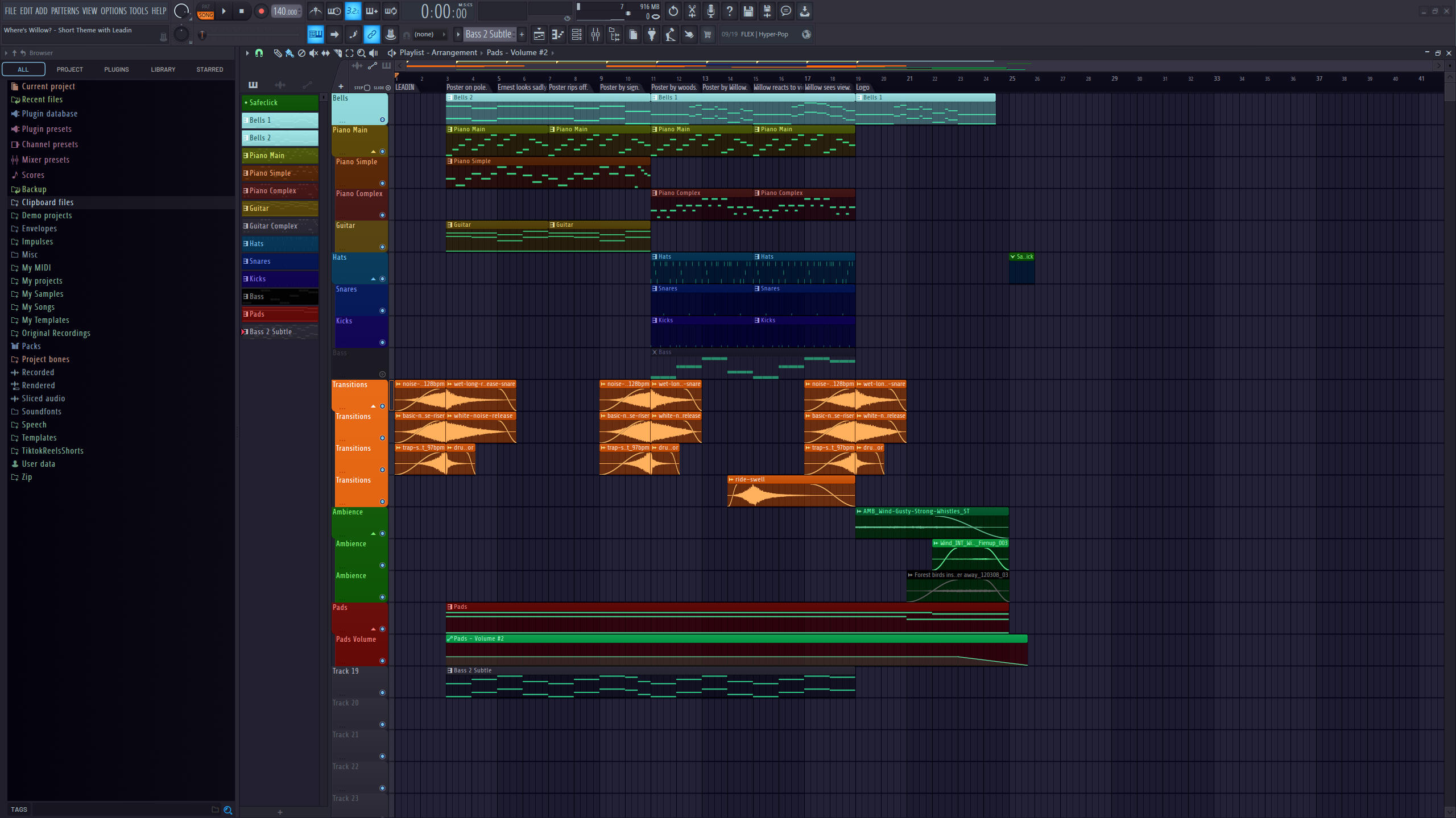
A screenshot of the FL Studio project for the Where's Willow? intro theme.
Music:
• Music for Firefly City Stories is made using FL Studio. I mainly use the stock plugins, especially Sytrus. As far as external plugins, I will occasionally use CamelCrusher (sorry I can't link to this as it's been discontinued since 2015 and I can't guarantee any existing links are safe) for bass shaping and Cymatics Origin for a lofi sound.
• Out of all of the parts of making FCS, music production and photography were my first major hobbies in life. I started both around 13 years old or so, but kept most of my work private until now. Some of the songs and photos you find in FCS now are actually the updated versions of things I started as early as high school on an old iPad mini using Garageband... When I started making music, I was mainly focused on making bass trap music (the kind of music that is the focus of YouTube channels such as Bass Nation). I still make music like this for fun, but don't really know what to do with it when it's finished...
• Occasionally I will sing in songs, but in order to avoid embarrassing myself I clean it up very slightly using Melodyne lol.
• The music software I use is probably the most expensive software in the workflow, but I got most of it through sporadic upgrades over the course of a decade during big sales (Black Friday, Cyber Monday, summer sales, etc.). If you want to get them you can save a LOT by doing it that way. Also I originally bought them just for my music production activities, but they also luckily came in handy for making FCS.
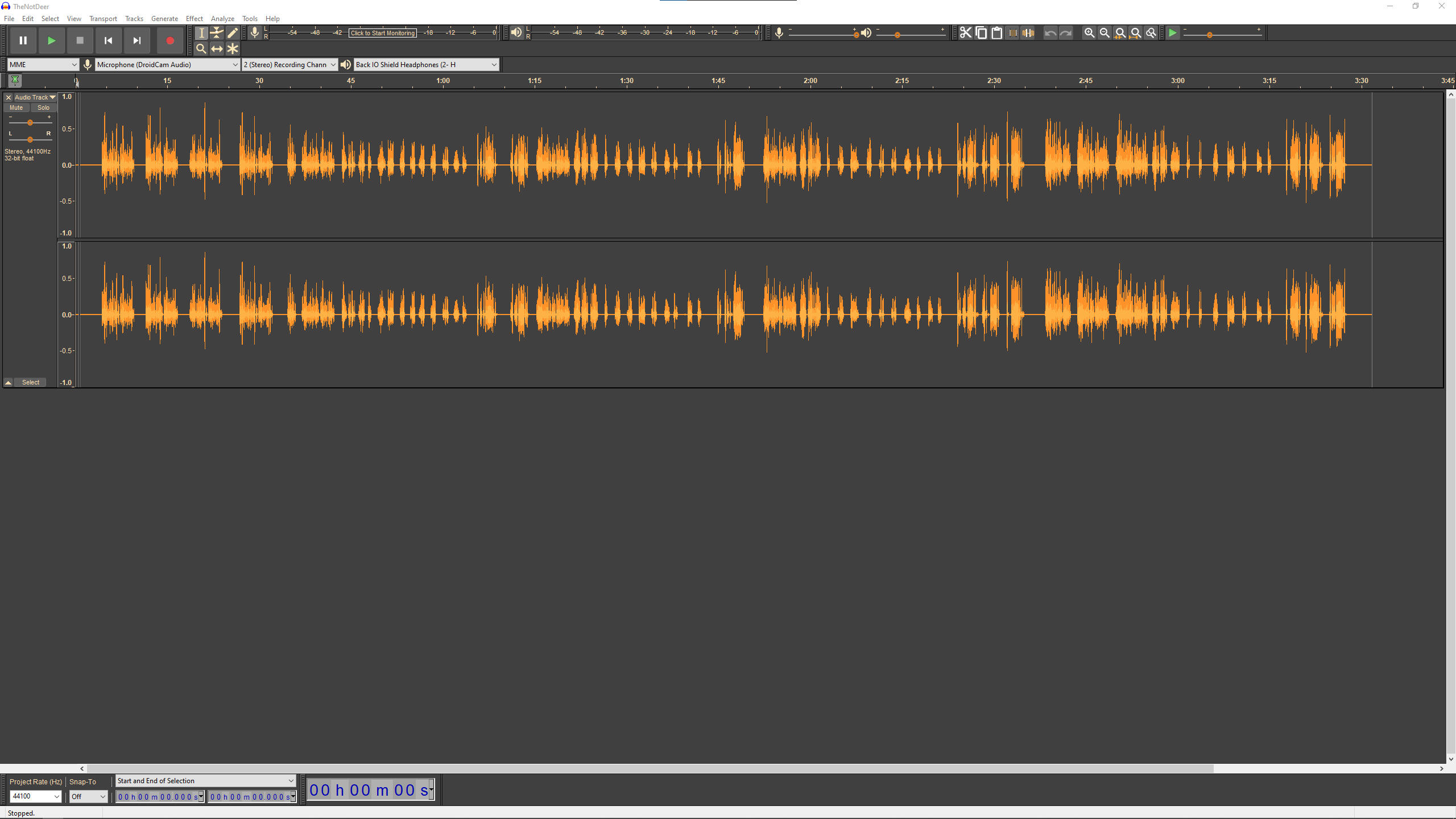
A screenshot of the Audacity project for a Where's Willow? short video. I do several takes of each line as shown by the repeating patterns.
Voice Acting:
• I do a lot of voice acting in FCS myself. For me, these stories are often so personal that I don't even really have to act at all; I just relive certain things and all of the emotions become real anyway.
• When recording, I use Audacity v2.4.2 (the latest version I trust, though I'm considering making the switch to Reaper or just using FL Studio for this too) through a Focusrite Scarlett Solo along with a Rode NT1 5th-generation condenser microphone. Occasionally I also use a Samson Q2U dynamic microphone or even a Fifine K670B condenser mic. I use a pair of Beyerdynamic DT-770 Pro 80Ω headphones to monitor low-end sound, with a pair of Audio-Technica ATH-M20x's as a backup to test higher-frequency noises. I was lucky enough to take an audio engineering class in college (even though it had nothing to do with my major lol), without which I would probably not be as familiar with how to record and process audio.
• When I can't voice characters myself, I cast voice actors (usually on Casting Call Club) to fill important roles. When I open these calls, I usually post about it on FCS social pages.
• Though I listed it after animation in the list, voice acting specifically for scenes with lip sync is done in advance. There is no ADR or dubbing in FCS (that wouldn't make sense lol).
Sound Effects and Foley:
• I usually get my sound effects from two main places; either recording them myself or licensing them form Sonniss.com. Sometimes I will find a few CC0 sound effects on Freesound.org, but I try to keep this to a minimum for several reasons. I have also used public domain sound effects provided by Yellowstone National Park in Where's Willow?.
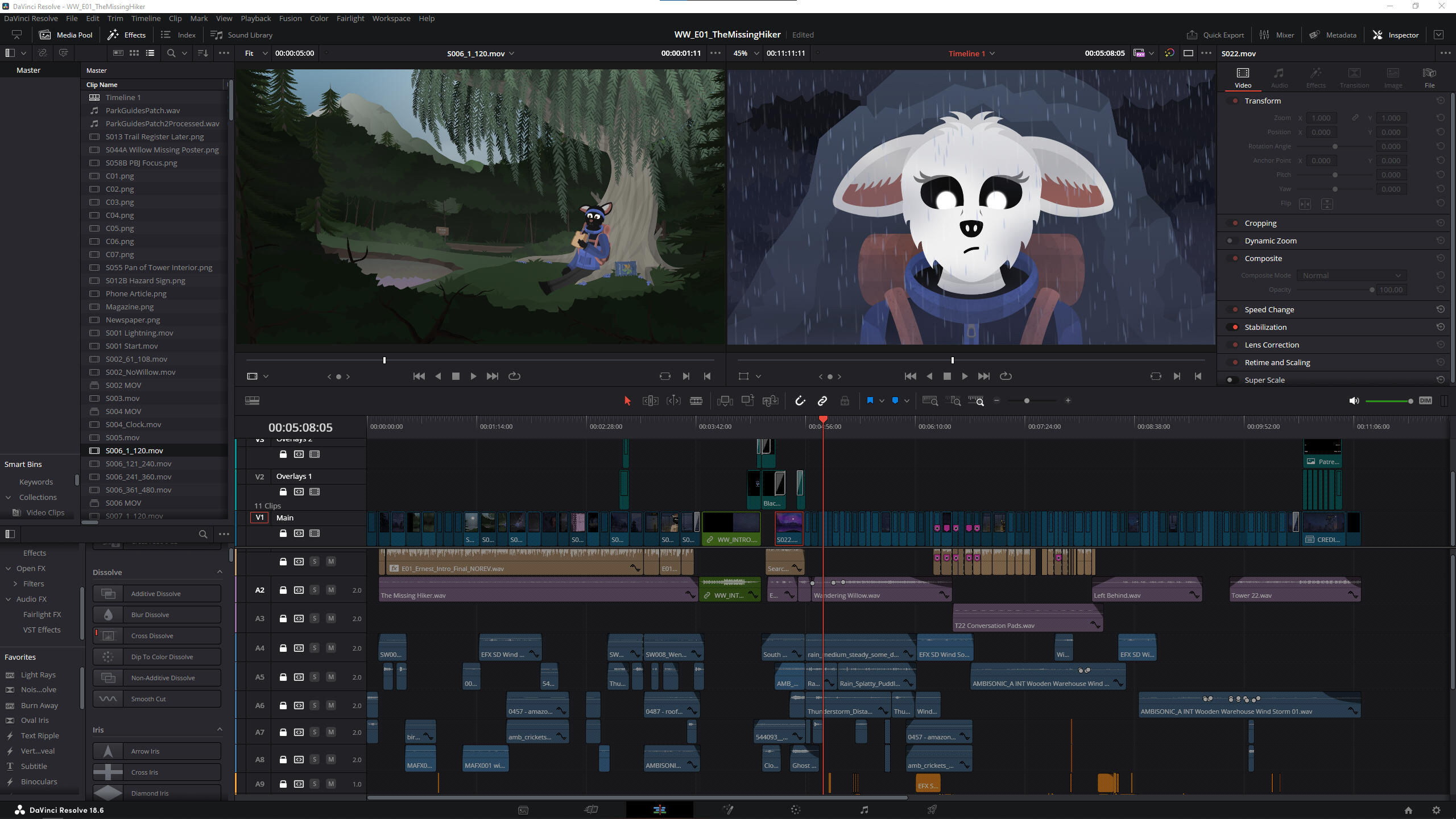
A screenshot of the DaVinci Resolve timeline for episode one of Where's Willow?
Editing:
• To edit videos, I use DaVinci Resolve. Everything in the previous steps finally gets to come together here, and it's always a cool thing to see. I usually place in each clip, align the voice acting audio, then add music and time things accordingly. Once timings are set, I'll add in foley before adding effects and processing volumes.
• Once editing and compiling is done, I export the 1080p timeline to a 4K .mov in DNxHR HQ with LPCM audio (yes somehow it lets me do this lol) before compressing things down to a 4K h.265 AAC .mkv file in Handbrake (result is usually around 1% the file size of the .mov but with the same percievable quality). This order of operations ensures the highest possible quality to upload to sites like YouTube and Newgrounds without artifacts or huge upload times. For reference, the average Where's Willow? episode was 70GB in it's raw .mov form, but only about 1.5GB once compressed. Though I'm used to it by now, the first time I went through the process it was like a roller coaster, lol.
• I will occasionally use external plugins such as Soundly Place-It and DearVR Micro for immersive headphone audio. The best example of this would be the thunder and lightning in Where's Willow? Episode One: The Missing Hiker.
Who makes FCS projects?
Hi! My name is Mitch Ran, and I’m a graphic designer, 2D rig animator, and comic artist from the Cincinnati, Ohio area. My other pastimes include creative writing, music production, voice acting, photography (primarily of nature), and scenery artwork.Before working on Firefly City Stories, my main creative project has been WebCanids comics, a gag-based comic featuring canids such as foxes, wolves, and coyotes in cute and funny adventures. I still create this comic alongside FCS, and share new ones every week! I have also made several fan animations for video games that I enjoy on my old fan art channel, though I've put this on hold for the forseeable future.
Other Frequently-Asked Questions:
More questions that have (much) shorter answers!
What is the chronological order of the stories in-universe?
• Where's Willow? occurs around five years before Bluefire Books. I try not to use exact years for actual stories (just the lore), but they would both be set roughly in the 2010's (but still a fictional universe). There are hints of that here and there.Who is the intended audience of Firefly City Stories?
• Firefly City Stories (FCS) is intended for young adult audiences and older. Most of the stories in this universe revolve around early adult life, college, and other situations that probably won't resonate as much with anyone younger.How is FCS made?
• Writing for FCS is currently done in Notion and Google Docs (though I'm trying to switch to Obsidian and LibreOffice). Artwork is created in Affinity Designer. Animation is done using Tahoma2D, an open-source fork of Opentoonz. Editing is done using DaVinci Resolve. Music is made using FL Studio.
• For an in-depth writeup, see above.
• There is absolutely zero use of generative artificial intelligence in any part of Firefly City Stories production whatsoever. Doing so would defeat the purpose of working on Firefly City Stories in the first place.How is FCS funded?
• FCS is entirely self-funded out of pocket. Costs are kept down primarily due to the fact that it is largely a solo, self-made project. It does have a few crowdfunding options (Patreon and Ko-Fi) available for donations, which are much appreciated. There is also a merchandise store.Are any things in FCS based on real life?
• Events, characters, places, and entities in FCS are fictional abstractions. Any relation to real events, characters, places, or entities is coincidental only.Is FCS hiring, casting, or looking for ideas?
• Thanks for your interest, but Firefly City Stories is largely a solo project at the moment, with the exception of voice acting in animations. This may change someday, but it will be announced if so on FCS social media. Keep an eye out!
The World of Firefly City Stories
Firefly City is a major city within the country known as the Commonwealth of Aurora (COA). It sits along the country’s east coast in a cool-weather, sub-alpine environment.Much of this lore was written in 2020 when I was laying the groundwork for what at the time was going to be a single project. I filled things out as I had more and more ideas until 2023, at which point I made the final district and park maps. The world maps were made later in 2025 in preparation for Pilot Light.
Map
Click the maps to see them more closely!
1) A map of the districts and immediate surroundings of Firefly City.
2) A map of the Sunset Valley region of the Starlight Mountains National Park and Preserve.These maps were made by hand by me, Mitch R.
Districts
Firefly City is divided into several districts, each with its own unique atmosphere.
Climate
Firefly City's cultural dynamics, and aesthetics are driven largely by climate.
Economy
The economy of Firefly City is a key factor in many of the stories that happen there.
Culture
Firefly City is known for being cold— both physically and socially.
History
Firefly City has a haunting history full of grand triumphs and atrocious shortcomings.
Further Out
Click the maps to see them in larger form!
(They are very large so it may be best to just download them).
1) A "paper" map (c. 1926) of the world of Firefly City Stories, with names as they are known in Firefly City itself.
2) A "satellite" map of the modern world of Firefly City Stories, with names as they are known in Firefly City itself.
3) The modern world of Firefly City Stories in "planet" form as projected using NASA and Goddard Institute's G. Projector program.
4) The modern Earth of Firefly City Stories in "planet" form (see above) along with the Moon, Milky Way starband, and Andromeda Galaxy.These maps were made by hand by me, Mitch R. The initial map design alone took around two months (mainly climate, plate tectonics, and toponymy). Cartography is a special interest of mine lol.
There is more beyond the boundaries of Firefly City!
Landmasses, Regions, and Oceans:
Lumen
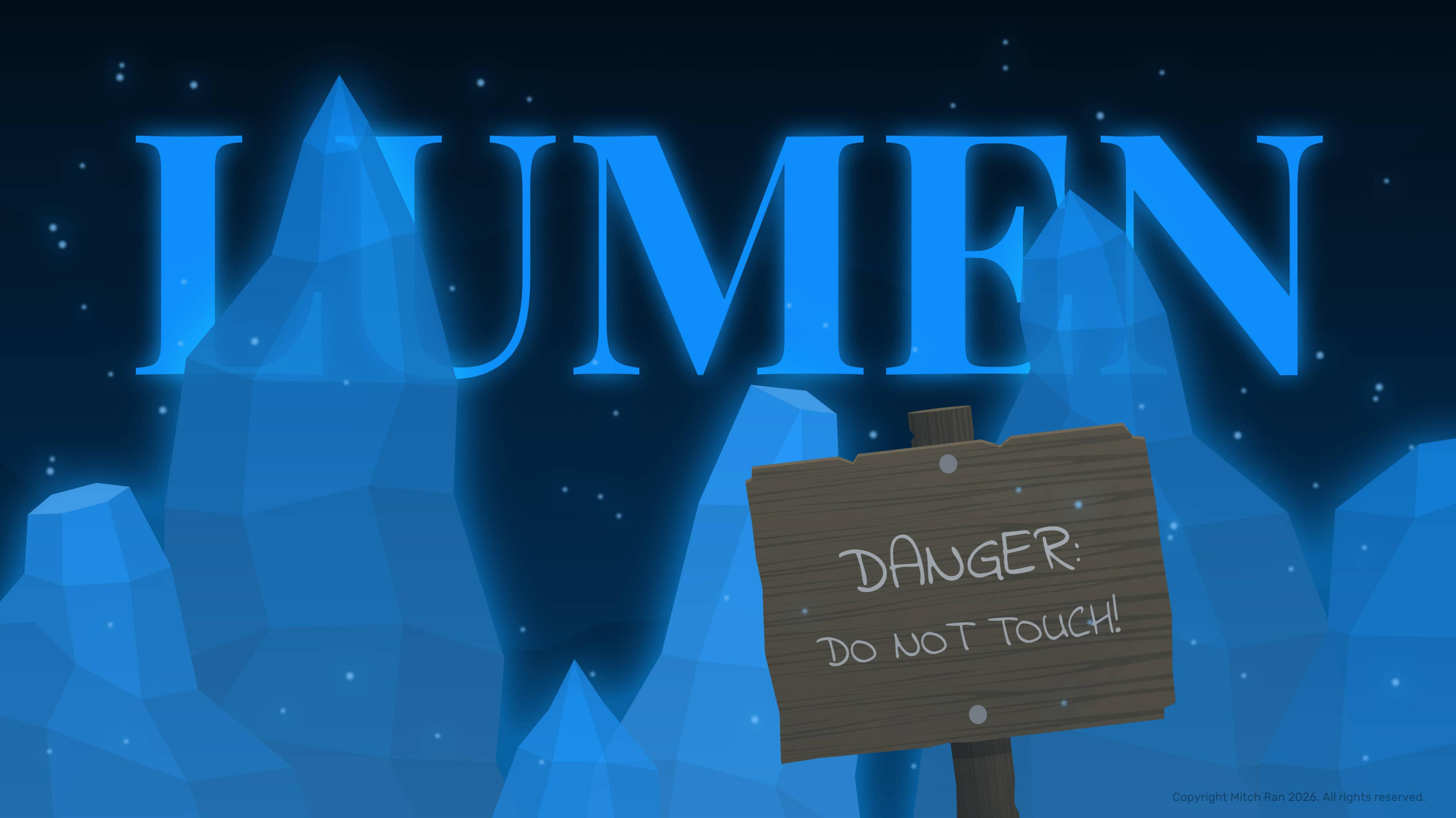
In the world of Firefly City, lumen is an extremely volatile substance that exists naturally as blue, glowing underground crystals. It forms naturally in caves, ravines, and underwater environments. Despite its familiarity and relative abundance, the formation processes of lumen are still a mystery.Lumen crystals are mined and distilled into various forms, such as oils, powders, gases, and smaller crumbled chunks, all of which are used as an energy source. Lumen is most dangerous as a large, solid mass, in which state it behaves as a very unstable explosive that can be triggered by small sparks, impacts, or electrical charges.As stated, lumen emits a faint blue glow, and this glow has occasionally been used, in dire times, as a light source. The effects of close proximity to lumen, however, are known to be hazardous, with individuals who are exposed to lumen in any form for prolonged periods of time experiencing respiratory symptoms, nausea, atrophy, and hallucinations. High-level, saturated exposure without mitigation can result in death. Sudden, violent exposure can result in worse...In modern times, the environmental effects of lumen use are largely recognized as negative, with vast tracts of land cleared for mining the substance and ecosystems surrounding areas with lumen energy plants disappearing or dying off over time. Many groups advocate for elimination of lumen as a resource in favor of safer, more environmentally-friendly options such as wind, solar, hydroelectric, and nuclear power generation.Those who oppose the elimination of lumen use state that it is a part of the heritage of the Commonwealth of Aurora, especially Firefly City, with even the national colors being based on the substance. This debate has existed for decades with little to no movement in either direction. Even after disasters such as the Great Split and the Great Canal Flood, lumen remains a popular resource and an economic driver.
Coming Soon...?
These are some hints for stories that might be coming soon to the world of Firefly City!
Hints for existing stories are included (struckthrough) as examples.Remember, nothing is guaranteed as some things get skipped, merged, or altered, but if you're feeling curious...
I hope this works out...(Bluefire Books)Wish you were here...(Where's Willow?)Illuminate the darker waters...(Pilot Light)I hear rumbling underground...
Observe. Record. Don't intervene. Do. Not. Intervene.
I f%#@ hate this place...
I wanna go home...
FCS Quick Links
The following buttons link to official pages of various Firefly City Stories content.
Social media pages:
Black icons are inactive pages, but the profiles linked are still official.
Financially support:
Support is very much appreciated!
Read comics:
Comics can also be read on most FCS social media pages.
Stream or download music:
Music I make is automatically put on these by my distributor (except for Bandcamp, which I do manually).
Individual Stories:
Reactions and Commentary
Thank you for your interest in creating reaction or commentary content around Firefly City Stories projects!Creating Firefly City Stories is no small task. In order to keep things fair and ensure that I can get the proper benefits from my own work, all reaction or commentary content around Firefly City Stories projects must follow the below policy to be permitted.This policy is not intended to be difficult or to sound unfriendly (on the contrary, I'm happy you're interested!), but I do have an obligation to protect my work, rights, and the work and rights of those I have collaborated with on these projects. As such, the wording has to be a bit firm.Thank you for understanding, and being considerate.
- Mitch Ran
Reaction/Commentary Policy
Policy for reactions or commentaries on Firefly City Stories content is as follows:➊ The reaction/commentary should not function as a substitute for watching the original media on the Firefly City Stories channel (or elsewhere). The focus should be on your reaction/commentary, not on the original video. This should be achieved via some or all of the following:○ Showing parts of the original instead of the whole thing.
○ Pausing frequently to share your thoughts.
○ Waiting a fair amount of time after the release of the original to make reactions or commentary (1 week minimum preferred).➋ Proper credit is required. Proper credit consists of:○ A verbal mention of the Firefly City Stories channel in reaction/commentary video/stream itself.
○ A link to the Firefly City Stories channel within the first few lines of the reaction/commentary video's description.
○ Links to the FCS Patreon, Ko-Fi, and Merch Store would be appreciated, as financial support allows me to make these stories in the first place.➌ I reserve the right to take necessary action to protect my work if this policy is not followed.-----⚠ EXTRA NOTE:○ Firefly City Stories content contains original copyright-protected music.
○ This is labeled by my music distributor automatically through contentID.
○ I cannot "whitelist" any specific channel, even my own.-----Unauthorized reproduction, reuse, or reupload of Firefly City Stories content is strictly prohibited. Under absolutely zero circumstances is any Firefly City Stories content (in part or in whole) to be used for algorithmic or AI training of any kind.Reaction/commentary policies are subject to adjustment as needed.